Auxiliary Verb (Group 2) (Basic ㊦ 423)
Someone/something does something excessively or is in a state excessively.
Equivalent: Too; do something too much/often; over-
| (i) Vます | 過ぎる | |
| 話し過ぎる | Talk too much | |
| 食べ過ぎる | Eat too much | |
| (ii) Adjective {い/な} stem | 過ぎる | |
| 高過ぎる | Too expensive | |
| 静か過ぎる | Too quiet |
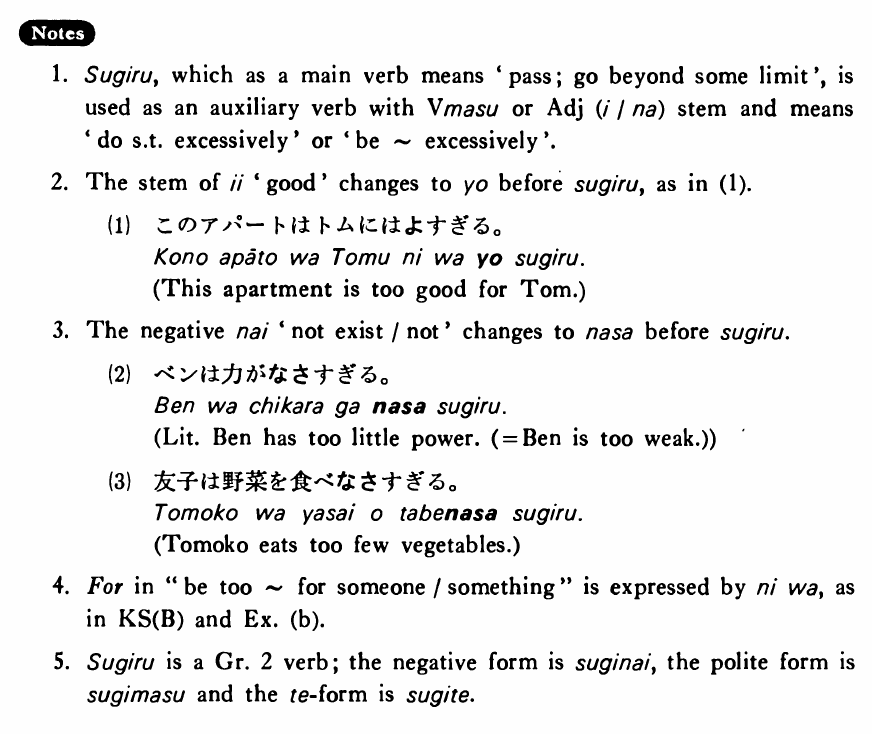
1. 過ぎる, which as a main verb means 'pass; go beyond some limit', is used as an auxiliary verb with Verbます or Adjective い/な stem and means 'do something excessively' or 'be ~ excessively'
2. The stem of いい 'good' changes to よ before 過ぎる, as in (1).
3. The negative ない 'not exist/not' changes to なさ before 過ぎる.
4. For in "be too ~ for someone/something" is expressed by には, as in Key Sentence (B) and Example (b).
5. 過ぎる is a Group 2 verb; the negative form is 過ぎない, the polite form is 過ぎます and the て form is 過ぎて.